
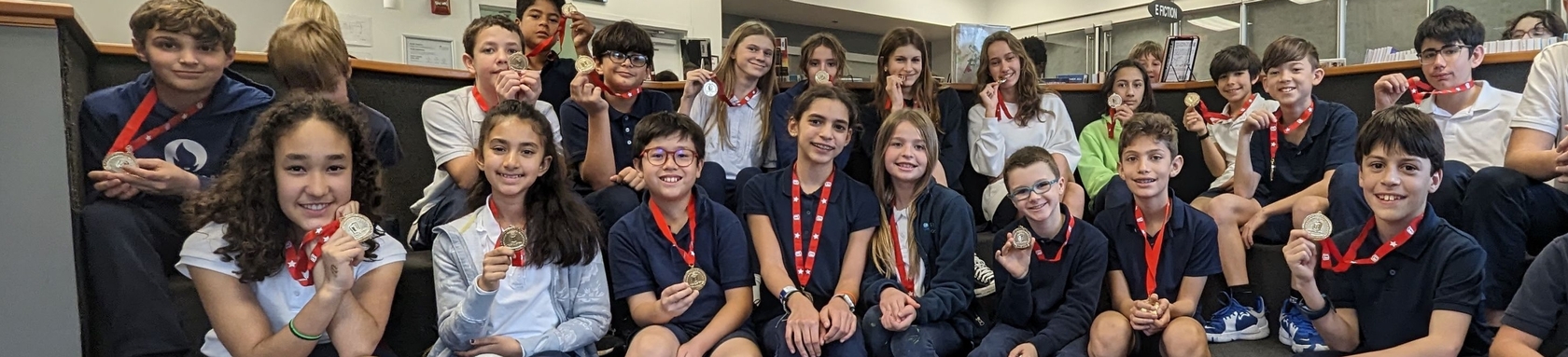
Course Criteria per Grade
Subject Overview
Sixth grade is an exciting year as students deepen their reading, writing, and communication skills. Through a rich selection of literary and non-literary texts, students develop foundational skills in reading, writing, speaking, listening, viewing, and presenting. The course emphasizes inquiry, critical thinking, creativity, and reflection—core components of the International Baccalaureate Middle Years Programme.
Students engage with diverse genres, including novels, poetry, drama, short stories, articles, media texts, and multimodal works. Learning experiences encourage them to analyze how writers use language, structure, and stylistic choices to convey meaning, and to craft their own texts with purpose and audience in mind. Students also practice giving and receiving feedback to refine their communication skills and build confidence as readers and writers.
Skills
Reading Objectives and End of Year Goals:
- Cite text evidence to support analysis
- Make inferences
- Determine theme and central idea
- Summarize texts/parts of texts
- Describe story structure
- Determine word meaning and analyze word choice
- Point of view
- Compare/contrast texts in genres and forms
Writing Objectives and End of Year Goals:
- Build development, organization and style
- Develop and strengthen through planning, revising, editing, rewriting, trying a new approach
- Use technology to collaborate, produce and publish
- Research
Argument/Opinion:
- Organize evidence
- Support claims
- Use credible sources
- Improve word choice
- Build formal style
- Develop conclusions
Informative/explanatory:
- Organize information
- Develop topic
- Use transitions and domain-specific vocabulary
- Build formal style
- Develop conclusions
Narrative:
- Establish context and organize events
- Develop writing using narrative techniques
- Develop sequence, time shifts, and shifts in setting
- Use descriptive and precise language
- Develop conclusions
Content
Types of Writing:
- Narrative: Writing stories with dialogue and description
- Opinion: Making a claim and supporting it with evidence
- Research: Develop a research question that the paper will address through evidence from sources
Literature:
- The Golden Compass, by Philip Pullman
- Roll of Thunder, Hear My Cry, by Mildred D. Taylor
- Diary of a Young Girl, by Anne Frank
Reading focus:
- Fiction:
- Identifying themes and lessons in stories
- Analyzing characters and how they change
- Understanding the plot and how events connect
- Nonfiction:
- Finding the main idea and key details
- Understanding how authors use facts and evidence
- Using text features to gather information
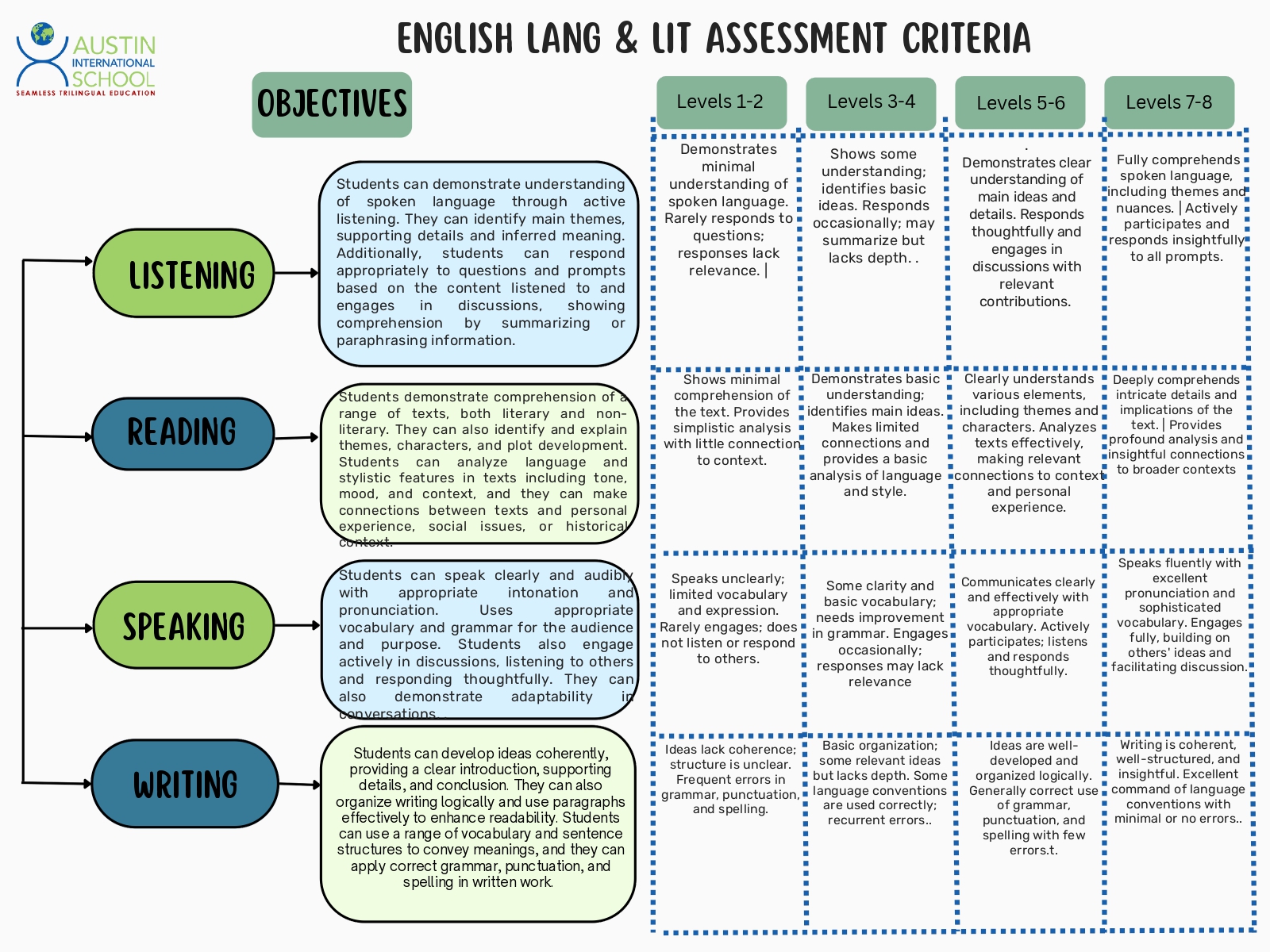
IB MYP Assessment Criteria
Subject Overview
MYP English Language & Literature Year 2 builds on the foundational skills developed in Year 1 by deepening students’ understanding of how language shapes meaning, identity, and perspective. Students read increasingly complex literary and non-literary texts and learn to analyze them with greater independence, sophistication, and nuance. Through inquiry-driven units, students explore how authors use language to inform, influence, entertain, and challenge their readers.
Throughout the year, students develop their voice as writers and communicators. They engage in a wide range of writing tasks—analytical, creative, and argumentative—and refine their ability to craft clear, purposeful, and expressive texts. Students also strengthen their speaking, listening, and media literacy skills through collaborative discussions, performances, debates, and multimodal presentations.
Skills
Reading objectives :
- Cite strong evidence from the text to support their ideas
- Analyze how characters interact and how plots and themes develop
- Determine the meaning of words and phrases, including figurative language
- Compare and contrast different forms of literature (stories, poems, dramas)
- Use evidence to explain what a text says and what it implies
- Analyze the structure of arguments and evaluate reasoning
- Understand how ideas and events influence each other in nonfiction
- Determine central ideas and explain how they’re developed across a text
Writing objectives and end of year goals:
- Argumentative writing: Making a claim and supporting it with evidence
- Informative/explanatory writing: Clearly explaining ideas or concepts
- Narrative writing: Crafting engaging stories with structure and description
Speaking and listening:
- Participate in discussions, building on others’ ideas respectfully
- Present claims and findings clearly, using relevant evidence
- Adapt speech for different audiences and purposes
- Evaluate the reasoning and evidence in speakers’ arguments
Language:
- Strong command of grammar, usage, and conventions
- Skills to choose precise words for clarity and effect
- Ability to use context clues, Greek and Latin roots, and reference materials to understand vocabulary
- Understanding of figurative language, word relationships, and nuances
Content
Types of Writing:
- Narrative
- Persuasive
- Poetry
Literature:
- The Hobbit, by J.R.R. Tolkien
- The Crossover, by Kwame Alexander
- I Will Always Write Back, by Caitlin Alifirenka, Liz Welch, and Martin Ganda
Reading Focus:
- Fiction:
- Analyzing how elements of a story (setting, plot, characters) influence one another
- Identifying and tracing themes across a text
- Examining how an author develops a point of view
Nonfiction:
- Determining central ideas and summarizing objectively
- Analyzing how authors organize information (cause/effect, problem/solution, compare/contrast)
- Evaluating how authors use evidence and reasoning to support claims
MYP Assessment Criteria
Subject Overview
In 8th grade English Language Arts, students strengthen their skills as readers, writers, speakers, and critical thinkers to prepare for high school and beyond. Through a diverse selection of literature—from classic texts to contemporary works—students analyze how authors develop themes, structure arguments, craft characters, and use language intentionally. Students will deepen comprehension skills, strengthen vocabulary through reading, and explore how language shapes ideas, identity, and perspective.
Writing is a major focus of the course. Students will engage in informative, argumentative, and narrative writing, developing clear thesis statements, supporting claims with relevant evidence, and organizing ideas with coherence and purpose. They will refine grammar, sentence fluency, and style through drafting, revising, and peer review. Research skills are emphasized as students learn to gather information from credible sources, cite evidence, and integrate information effectively to support thinking.
Skills
Reading objectives:
- Cite the most relevant evidence to support analysis and inferences
- Analyze how dialogue and incidents develop the plot and reveal character
- Understand how word choice shapes meaning, tone, and mood
- Compare and contrast the structure and style of different texts, including themes across genres
- Evaluate claims and distinguish between supported and unsupported reasoning
- Identify central ideas and analyze how they develop over a text
- Examine how authors use structure, word choice, and evidence to convey meaning
- Compare and contrast key ideas across multiple texts on the same topic
Writing objectives:
- Argumentative writing: Present claims logically with strong evidence and counterarguments
- Informative/explanatory writing: Convey complex ideas clearly and accurately
- Narrative writing: Develop real or imagined experiences with effective pacing and description
Speaking and listening:
- Engage in discussions, build on others’ ideas, and express their own clearly
- Evaluate a speaker’s reasoning, claims, and evidence
- Present information using logical sequencing and relevant multimedia when appropriate
- Adapt speech to different contexts and tasks, demonstrating command of formal English when needed
Language:
- Mastery of grammar, punctuation, and conventions in writing and speaking
- Ability to use precise and varied vocabulary to convey meaning effectively
- Strategies to determine word meaning using roots, context, and reference tools
- Understanding of figurative language, connotations, and word relationships
Content
Types of Writing:
- Narrative
- Persuasive
- Research
Literature:
- Scythe, by Neal Shusterman
- I Am Malala, by Malala Yousafzai
- No Fear Shakespeare: Julius Caesar, by William Shakespeare
Reading Focus:
- Fiction:
- Analyzing how elements of a story (setting, plot, characters) influence one another
- Identifying and tracing themes across a text
- Examining how an author develops a point of view
- Nonfiction:
- Determining central ideas and summarizing objectively
- Analyzing how authors organize information (cause/effect, problem/solution, compare/contrast)
- Evaluating how authors use evidence and reasoning to support claims
MYP Assessment Criteria