
Course Criteria per Grade
Subject Overview
Students will strengthen their written communication, reading comprehension, idea sharing, critical thinking, and collaboration skills. They will deepen their linguistic competencies to better understand and appreciate literature. They will also apply spelling, grammar, and vocabulary rules with increasing consistency and confidence.
Skills
Oral Language:
- Listen to a story and demonstrate understanding by answering questions without referring to the text
- Saying a text aloud from memory
- Make a short oral presentation based on notes or slide shows or other digital tools
- Interact constructively with other students in a group to confront reactions or points of view
Reading and Understanding:
- Read, understand and interpret a literary text adapted to his age and react to his reading
- Read and understand texts and documents (texts, tables, graphs, diagrams, diagrams, images) to learn in different discipline
Writing:
- Write one to two-page text adapted to the recipient
- After revision, get an organized and coherent text, with the writing readable and respecting the orthographic regularities studied during the cycle
Study of the Language (grammar, spelling, lexicon):
- In writing texts in various contexts, mastering chords in the nominal group (determinant, noun, adjective), between the verb and its subject in simple cases (subject placed before the verb and close to him, subject composed of a nominal group comprising at most one adjective or complement of the noun or subject composed of two nouns, inverted subject according to the verb) as well as the agreement of the attribute with the subject
- Reasoning to analyze the meaning of words in context and using morphology
Content
Units of Study:
- Grammar
- Vocabulary
- Conjugation
- Creation and Poetry
- Monsters and Mythology
- Utopia versus Dystopia
- Studies of Adventure Stories
Literature:
- L’Odyssée, by Homère
- Thésée, Ariane et le Minotaure, by Évelyne Brisou-Pellen
- L'affaire Caius, by Henry Winterfeld
- Tom Sawyer, by Mark Twain
- Le passeur, by Lois Lowry
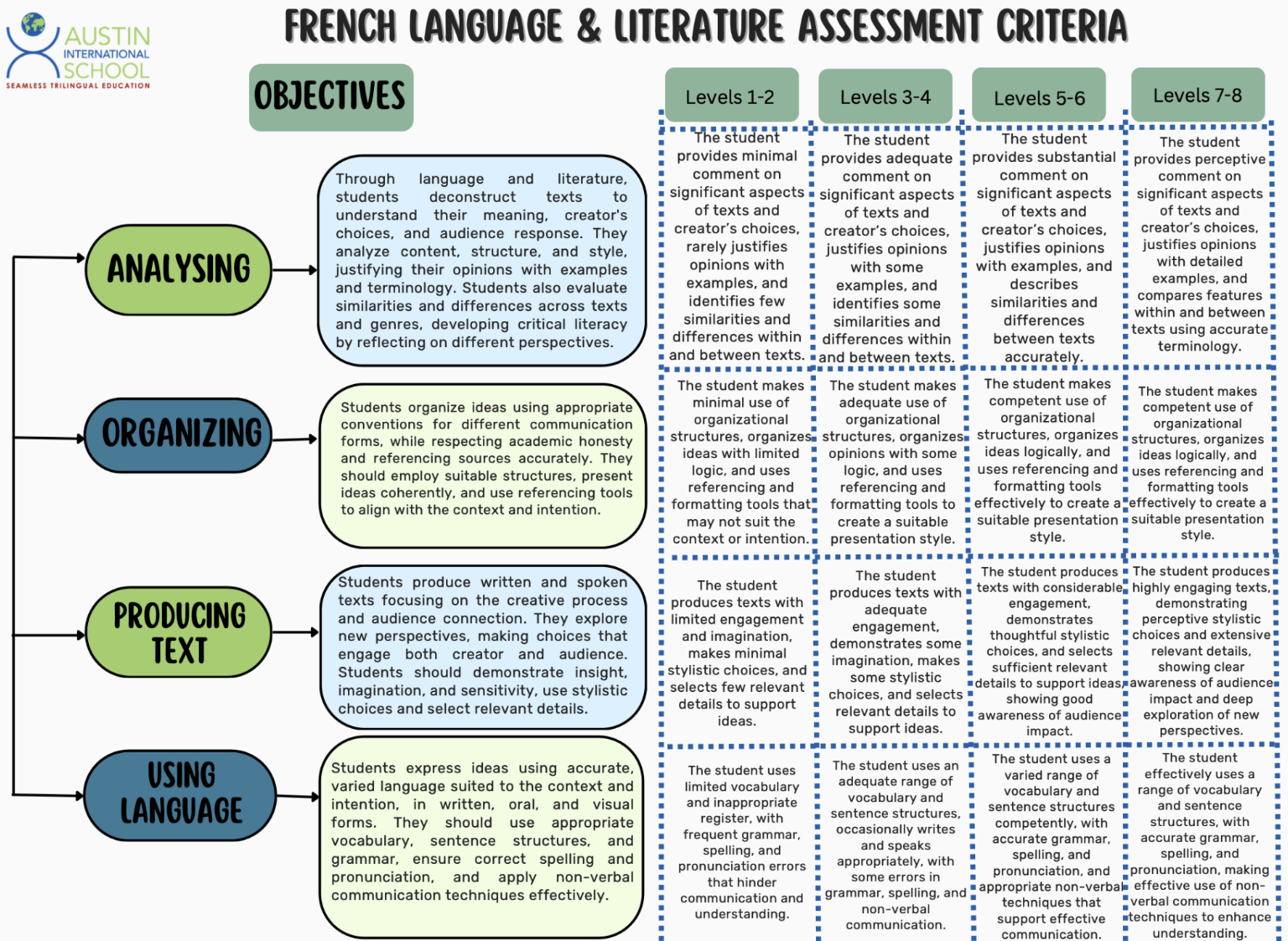
IB MYP Assessment Criteria
Subject Overview
In Year 2 of MYP French Language and Literature, students continue to develop their proficiency in French while deepening their understanding of literary forms, language use, and cultural contexts. This course emphasizes critical reading, analytical writing, and oral communication, enabling students to engage thoughtfully with a variety of texts, including fiction, non-fiction, poetry, drama, and media.
Students explore both classic and contemporary French literature, examining themes, stylistic devices, and cultural perspectives. They are encouraged to express their ideas clearly and creatively in written and spoken French, while refining their grammar, vocabulary, and sentence structure.
The course also focuses on developing students’ skills in literary analysis and interpretation, helping them to identify authorial intent, perspective, and technique. Collaborative projects and discussions foster intercultural understanding and communication skills, preparing students to interact confidently in French across academic and real-world contexts.
Skills
Oral language:
- Understand elaborate oral speeches (story, lecture, documentary program, news journal)
- Produce a continuous oral intervention of five to ten minutes (presentation of a literary or artistic work, presentation of the results of research, defense argued from a point of view)
- Interact in a debate in a constructive way and respecting the word of the other
- Read a text aloud in a clear and intelligible way; to say from memory a literary text; engage in a theatrical game
Writing:
- Communicate in writing and on various media (paper, digital) a feeling, a point of view, a reasoned judgment taking into account the recipient and respecting the main standards of the written language
- Formulate in writing his reception of a literary or artistic work
- In response to a writing instruction, produce an inventive writing part of a literary genre of the program, ensuring its consistency and respecting the main standards of the written language
- Use writing to think, create tools of work
Reading and understanding writing and image:
- To read and comprehend autonomously various texts, images and composite documents, on different media (paper, digital)
- Read, understand and interpret literary texts by basing the interpretation on some simple analysis tools
- Situate literary texts in their historical and cultural context
- Read a complete work and give an oral account of its reading
Language skills: study of language (grammar, spelling, lexicon)
- Analyze the properties of a linguistic element
- Appreciate the degree of acceptability of a statement
- Mobilize orthographic, syntactic and lexical knowledge in text writing in various contexts
- Revise one's writings using the appropriate tools
- Be able to analyze in context the use of lexical units, identify a lexical network in a text and perceive the effects
- Mobilize on reception and in the production of texts, linguistic knowledge allowing to construct the meaning of a text, its relation to a literary genre or to a kind of speech
Content
Units of Study:
- Grammar
- Vocabulary
- Conjugation
- Following Marco Polo
- Imagining new worlds
- How to become a hero
- Families, friends and networks
- Can humans control nature?
Literature:
- Le Livre des merveilles de Marco Polo, by Pierre- Marie Beaude (ongoing)
- Yvain ou le Chevalier au Lion, by Chrétien de Troyes
- Tristan et Iseut, by Béroul
- Le Malade imaginaire, by Molière
- Vendredi ou la vie Sauvage, by Michel Tournier
MYP Assessment Criteria