

Course Criteria per Grade
Subject Overview
The mathematics program is based on the French national education program (Cycle 3) but takes into account, as much as possible, the expectations of the American Common Core in order to allow for a smooth entry into high school. Mathematics are taught in both French and English.
IB MYP Mathematics Year 1 builds a strong foundation for students as they begin the International Baccalaureate Middle Years Programme. The course emphasizes conceptual understanding, problem-solving, and real-world application. Students explore how mathematical ideas connect across topics and how math helps them make sense of the world around them.
Skills
Number and Operations:
- Understand and use place value to compare, order, and perform operations with whole numbers, fractions, and decimals
- Apply factors, multiples, and prime factorization to solve problems
- Use the order of operations (including parentheses) accurately
- Estimate results and justify whether answers are reasonable
Algebraic Thinking:
- Represent patterns and relationships using tables, graphs, and algebraic expressions
- Simplify expressions and solve one-step linear equations
- Identify, describe, and generalize patterns using mathematical reasoning
- Interpret algebraic expressions and equations in real-world contexts
Geometry and Measurement:
- Classify and analyze 2D shapes and 3D solids based on their properties
- Calculate perimeter, area, volume, and surface area using appropriate formulas
- Apply transformations (translations, reflections, rotations) on the coordinate plane
- Use measurement tools accurately and convert between units
Data and Probability:
- Collect, organize, and represent data using various graphs (bar, line, histogram, stem-and-leaf)
- Calculate and interpret measures of central tendency (mean, median, mode, range)
- Make simple predictions based on data and probability models
- Identify variability in data and describe patterns or trends
Mathematical Communication & Reasoning:
- Explain solutions using diagrams, models, notation, and clear mathematical language
- Justify strategies and critique the reasoning of others
- Apply math concepts to real-world contexts and reflect on the effectiveness of chosen approaches
Content
Units of Study:
- Decimal numbers
- Fractions
- Measuring time
- Circles
- Perpenidcular bisectors
- Angles
- Perimeter and area
- Lines
- Line symmetry
- Triangles and quadrilaterals
- Three-dimensional geometry
- Proportional relationships
- Organizing and interpreting data
- Probability
- Algorithms and programming
IB MYP Assessment Criteria
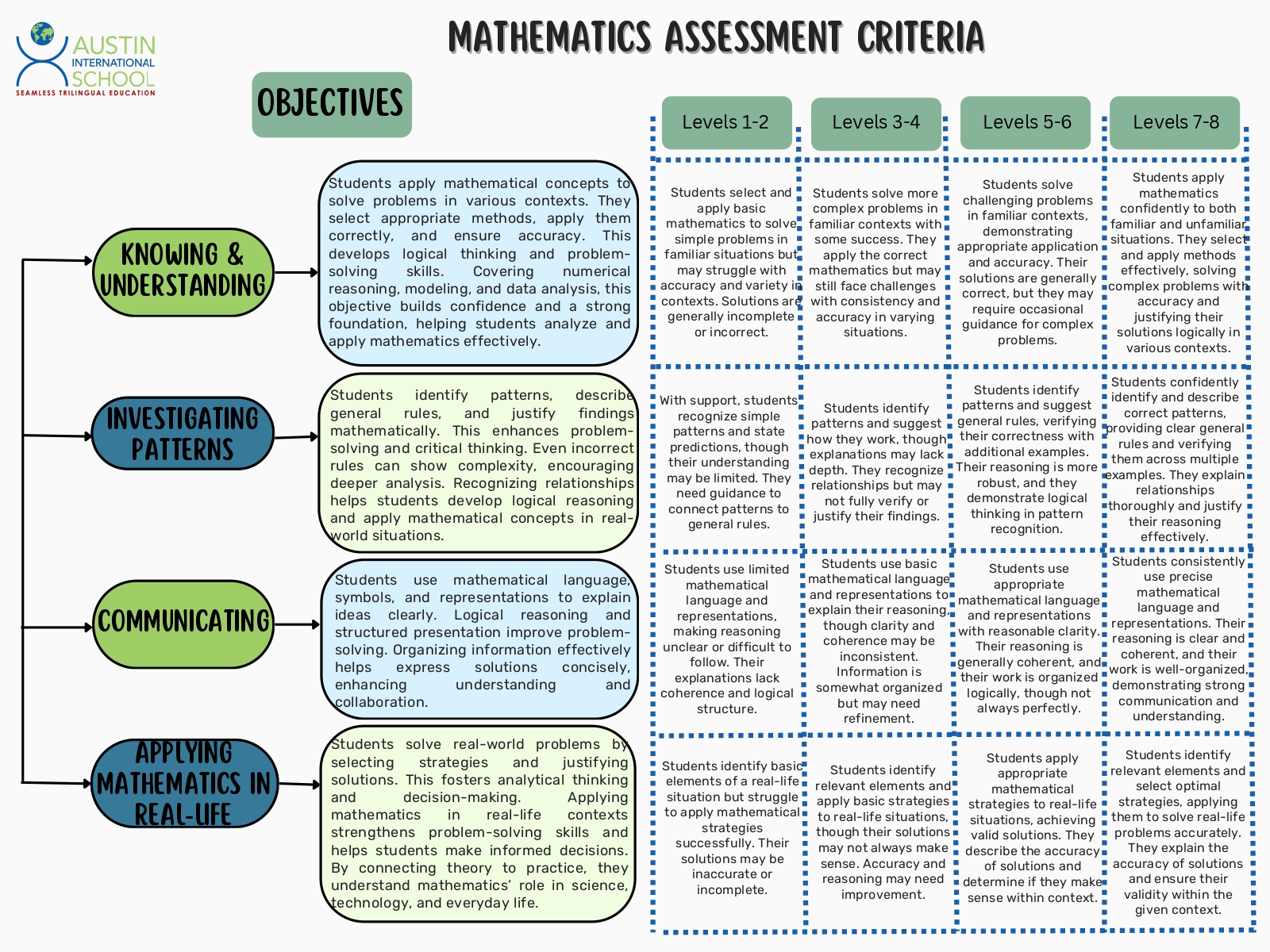
Subject Overview
The mathematics program is based on the French national education program (Cycle 4) but takes into account, as much as possible, the expectations of the American Common Core in order to allow for a smooth entry into high school. MYP Mathematics Year 2 extends the foundational knowledge built in Year 1 and challenges students to apply mathematics with greater abstraction, sophistication, and independence. Students explore deeper connections across mathematical strands and strengthen their ability to model real-world situations, justify reasoning, and communicate solutions effectively.
Skills
Number and Operations:
- Perform operations with rational numbers (fractions, decimals, integers) efficiently and accurately
- Apply ratios, rates, and proportional reasoning to solve real-world problems
- Use percentages to solve multistep problems involving increase/decrease, discounts, interest, and error
- Analyze and compare quantities using scale factors or proportional relationships
Algebraic Thinking:
- Simplify algebraic expressions using properties of operations
- Solve multistep linear equations and inequalities
- Represent relationships using tables, graphs, and algebraic rules
- Understand slope as a rate of change and use it to model linear situations
- Apply algebraic reasoning to patterns and sequences
Geometry and Measurement:
- Analyze and use angle relationships (vertical, supplementary, complementary, adjacent)
- Use similarity and proportionality to solve geometric problems
- Calculate area, surface area, volume, and scale dimensions of geometric figures
- Graph and interpret geometric figures on the coordinate plane
- Apply geometric reasoning to real-world contexts (maps, design, construction)
Data and Probability:
- Represent and analyze data using box plots, histograms, and comparative displays
- Calculate and interpret measures of central tendency and variability
- Recognize and describe distributions (cluster, gap, skew)
- Conduct probability experiments and compute probabilities of compound events
- Use data to make predictions and justify conclusions
Mathematical Communication & Reasoning:
- Use precise mathematical notation, vocabulary, models, and reasoning
- Justify solutions with logical arguments supported by calculations and diagrams
- Critique flawed reasoning and propose corrections
- Apply mathematics to unfamiliar, open-ended, or multistep challenges
Content
Units of Study:
- Decimal numbers
- Fractions
- Negative numbers
- Powers and exponents
- Proportional relationships
- Functions
- Statistical data and graphs
- Probability
- Transformations
- Parallelograms
- Three-dimensional geometry
- Triangles
- Algorithms and programming
MYP Assessment Criteria
Subject Overview
This course builds on students’ prior knowledge of mathematics to deepen their understanding of numerical, geometric, and algebraic concepts, preparing them for the study of higher-level mathematics in high school. Students will develop problem-solving skills, logical reasoning, and the ability to apply mathematical concepts to real-life situations.
The curriculum includes:
- Numbers and Calculations: Rational numbers, fractions, decimals, percentages, powers, and square roots
- Algebra: Introduction to algebraic expressions, linear equations and inequalities, proportionality, and simple functional relationships
- Geometry: Plane and solid geometry, including properties of figures, transformations (symmetry, translations, rotations), and calculation of areas, volumes, and perimeters
- Statistics and Probability: Data representation, interpretation, mean, median, and basic probability concepts
- Problem-Solving: Applying mathematical reasoning to multistep problems in various contexts, fostering critical thinking and analytical skills
Skills
Develop Numerical and Algebraic Fluency:
- Perform calculations with fractions, decimals, percentages, powers, and roots
- Manipulate algebraic expressions and solve linear equations and inequalities
Understand Geometric Concepts:
- Analyze the properties of planes and solid figures
- Apply transformations such as symmetry, translation, and rotation
- Calculate lengths, areas, volumes, and perimeters in various contexts
Apply Mathematical Reasoning:
- Solve multistep problems using logical reasoning and structured approaches
- Recognize patterns and relationships in numbers, shapes, and data
Work with Data and Probability:
- Collect, represent, and interpret data using charts, tables, and graphs
- Calculate and analyze basic probabilities in real-world situations
Develop Critical Thinking and Problem-Solving Skills:
- Approach mathematical problems creatively and systematically
- Communicate solutions clearly, justifying reasoning both orally and in writing
Connect Mathematics to Real-Life Contexts:
- Use mathematical knowledge to understand everyday phenomena, practical tasks, and scientific concepts
Content
Units of Study:
- Fracions
- Negative numbers
- Algebraic expressions
- Powers and exponents
- Proportional relationships
- Functions
- Statistical data and graphs
- Probability
- Right triangles and trigonometry
- Transformations
- Three-dimensional geometry
- Triangles
- Algorithms and programming
MYP Assessment Criteria