
Course Criteria per Grade
Subject Overview
At the Capable level, students build upon their foundational knowledge of Spanish to communicate with increasing accuracy, complexity, and confidence. They learn to understand and produce connected language in a variety of familiar contexts, deepening both linguistic skills and cultural understanding. Through inquiry-driven units, students explore meaningful themes, strengthen interpersonal communication, and develop the ability to express more nuanced ideas about themselves and the world around them.
Skills
- Listening Comprehension: Understand main ideas and specific details in conversations and short presentations on familiar topics, including some less predictable contexts. Follow instructions and descriptions related to everyday tasks and leisure activities.
- Reading Comprehension: Identify main ideas, supporting details, and the writer’s intention in a variety of adapted and some authentic texts. Interpret information from short articles, brochures, and web pages, inferring meaning from context.
- Writing: Produce connected paragraphs with appropriate vocabulary and a range of tenses. Write descriptions, simple narratives, and short opinion pieces using cohesive devices.
- Speaking & Oral Interaction: Participate actively in conversations, asking and answering follow-up questions to maintain interaction. Give short presentations and narrate past events, plans, and experiences using a variety of structures.
- DELE A2 Escolar Preparation: Develop strategies to successfully complete all four skills of the official exam.
Content
Communication:
- Giving, asking for, and expanding personal information
- Talking about routines, schedules, and leisure activities with some detail
- Expressing and justifying likes, dislikes, and preferences
- Discussing meals, dietary habits, and cultural traditions related to food
- Narrating past experiences and describing holidays in sequence
- Shopping: describing products, comparing options, and expressing opinions
- Talking about animals, comparing them, describing habitats, and discussing their role in society
Grammar:
- Present tense (regular and irregular verbs)
- Reflexive verbs in different tenses
- Verb gustar and similar verbs (encantar, interesar, molestar)
- Verbs ir, tener que, querer and poder + infinitive
- Poder and deber + infinitive for expressing obligation/advice
- Conditional sentences with si + present
- Irregular verbs in -ger, -gir, -cer, -cir
- Future with ir a + infinitive and simple future (futuro simple)
- Impersonal se and passive voice with se
Vocabulary:
- Detailed personal information and expanded everyday topics
- Daily routines and habits with time expressions
- Time, school subjects, timetables, and academic activities
- Food, meals, ingredients, and recipes
- Shops, products, advertising, and consumer vocabulary
- Animals, habitats, environmental issues, and protection vocabulary
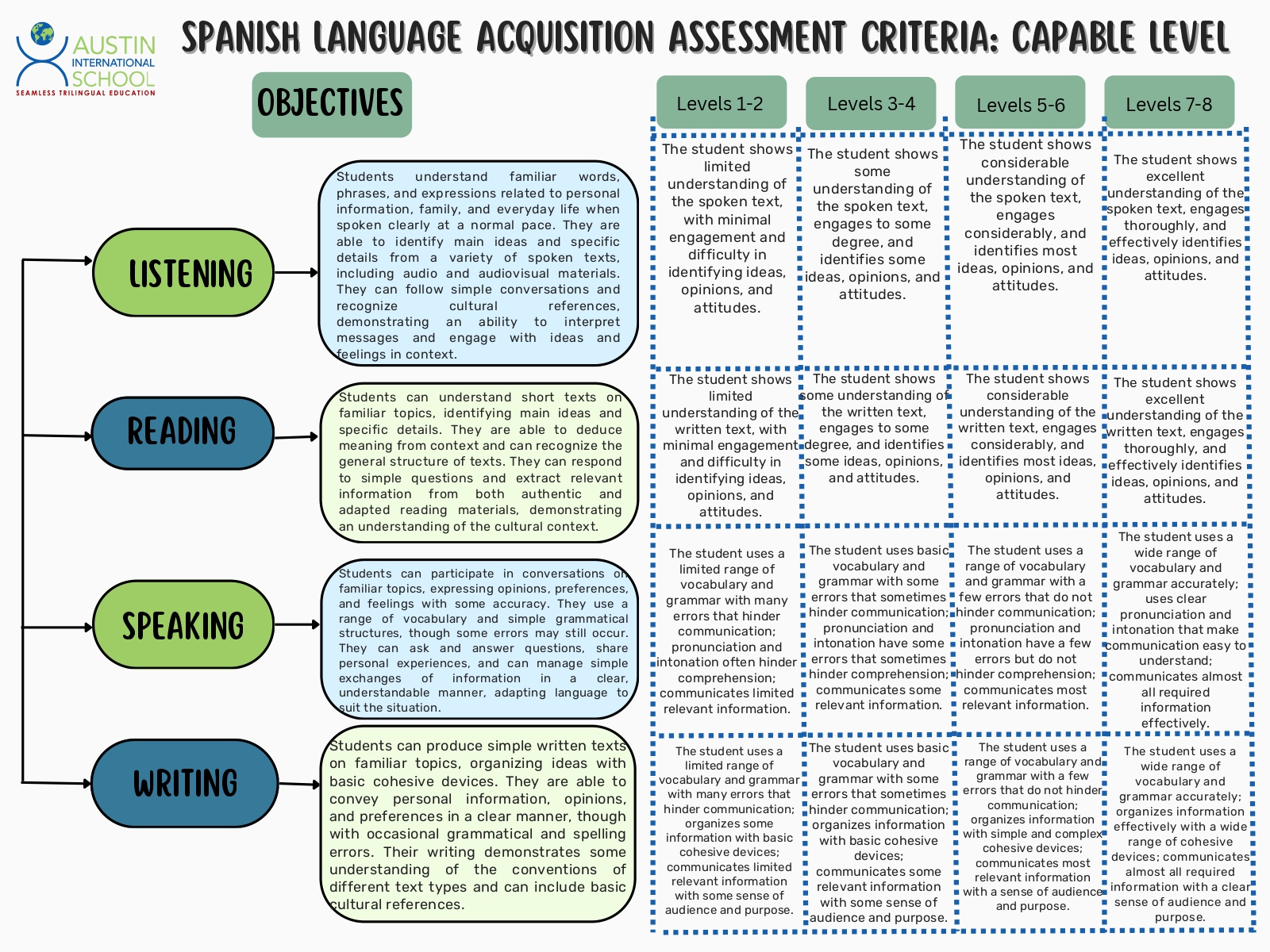
IB MYP Assessment Criteria
Subject Overview
In Year 2 of the Capable level, students continue to strengthen their Spanish language skills with a focus on increased independence, accuracy, and complexity. They deepen their ability to interpret and produce connected language across a wider range of social and cultural contexts. Students refine communication skills through inquiry, collaboration, and authentic tasks that highlight global contexts and intercultural understanding. The course encourages learners to express opinions, describe experiences, and analyze perspectives with growing confidence.
Skills
Listening Comprehension:
- Understand the main ideas, key details, and implied meaning in conversations, interviews, and short presentations on familiar and some unfamiliar topics
- Follow multistep instructions, explanations, and descriptions related to everyday life, academic contexts, and leisure activities
- Recognize changes in tone, mood, and attitude in speakers to interpret nuance
Reading Comprehension:
- Identify the main ideas, relevant details, and the author’s perspective in a variety of adapted and increasingly authentic texts
- Interpret and compare information from articles, brochures, emails, and web content, inferring meaning from context and identifying implicit information
- Recognize different text types and their purposes, adjusting reading strategies accordingly
Writing:
- Produce coherent multi-paragraph texts using a variety of tenses and cohesive devices
- Write detailed descriptions, narratives, and opinion pieces with supporting arguments
- Use appropriate register, vocabulary, and grammatical structures for different audiences and purposes
Speaking & Oral Interaction:
- Participate actively and spontaneously in conversations, asking for clarification, expanding responses, and maintaining interaction
- Give short, structured presentations on familiar and researched topics, integrating prepared and improvised language
- Narrate past events, describe ongoing situations, and discuss future plans using a variety of structures with growing accuracy and fluency
DELE B1 Escolar Preparation:
- Develop strategies to successfully complete all four skills of the official exam
Content
Communication:
- Expressing feelings, qualities, congratulations, and wishes
- Talking about personal relationships and describing people and objects
- Giving and checking information, expressing truth, doubt, or agreement/disagreement
- Describing phases of an action and comparing information
- Narrating recent events and explaining causes and consequences
- Giving definitions and identifying objects and people
- Expressing conditions (real or hypothetical) and giving advice
- Indicating location, qualities, and states; expressing surprise or incredulity
- Talking about trends, curiosities, and fashion
Grammar:
- Ser + noun / ser + adjective
- Qué + adjective / noun
- Phrases for expressing feelings, wishes, congratulations (¡Enhorabuena!, ¡Felicidades!, Que tengas suerte)
- Es + adjective/noun de valoración + que + present subjunctive
- Expressions with es verdad / es evidente / cierto / obvio que + indicative
- Negation with subjunctive
- Verbal periphrases: dejar de, acabar de, seguir sin, estar a punto de + infinitive
- Seguir / continuar + gerund
- Saber que, no saber que
- Relative clauses (specifying and explanatory)
- Opposition with que/quien
- Modal alternation
- Direct and indirect style
- Causal connectors: por + infinitive, es que, como
- Consecutive connectors: por eso, así (es) que, entonces, por lo tanto
- Si + present + present / simple future / imperative
- Aunque + indicative
- Ser without adjective for event location
- Contrast ser/estar
- Estar de + temporary profession
- Lexicalized imperatives (anda, vaya, venga, mira)
- Imperative + object pronouns (direct and indirect)
Vocabulary:
- Colloquial definitions of people and relationship expressions (llevarse bien/mal con alguien)
- Environment: recycling, climate change
- Adjectives and expressions for describing objects and people
- Complements and inventions
- Telephone and app-related vocabulary
- Food and nutrition vocabulary
- Fashion, trends, and sustainable fashion
MYP Assessment Criteria
Subject Overview
Year 3 of the course is a continuation of Year 2. Students continue to strengthen their Spanish language skills with a focus on increased independence, accuracy, and complexity. They deepen their ability to interpret and produce connected language across a wider range of social and cultural contexts. Students refine communication skills through inquiry, collaboration, and authentic tasks that highlight global contexts and intercultural understanding. The course encourages learners to express opinions, describe experiences, and analyze perspectives with growing confidence.
Skills
Listening Comprehension:
- Understand the main ideas, key details, and implied meaning in conversations, interviews, and short presentations on familiar and some unfamiliar topics
- Follow multistep instructions, explanations, and descriptions related to everyday life, academic contexts, and leisure activities
- Recognize changes in tone, mood, and attitude in speakers to interpret nuance
Reading Comprehension:
- Identify the main ideas, relevant details, and the author’s perspective in a variety of adapted and increasingly authentic texts
- Interpret and compare information from articles, brochures, emails, and web content, inferring meaning from context and identifying implicit information
- Recognize different text types and their purposes, adjusting reading strategies accordingly
Writing:
- Produce coherent multi-paragraph texts using a variety of tenses and cohesive devices
- Write detailed descriptions, narratives, and opinion pieces with supporting arguments
- Use appropriate register, vocabulary, and grammatical structures for different audiences and purposes
Speaking & Oral Interaction:
- Participate actively and spontaneously in conversations, asking for clarification, expanding responses, and maintaining interaction
- Give short, structured presentations on familiar and researched topics, integrating prepared and improvised language
- Narrate past events, describe ongoing situations, and discuss future plans using a variety of structures with growing accuracy and fluency
DELE B1 Escolar Preparation:
- Develop strategies to successfully complete all four skills of the official exam
Content
Communication:
- Expressing feelings, qualities, congratulations, and wishes
- Talking about personal relationships and describing people and objects
- Giving and checking information, expressing truth, doubt, or agreement/disagreement
- Describing phases of an action and comparing information
- Narrating recent events and explaining causes and consequences
- Giving definitions and identifying objects and people
- Expressing conditions (real or hypothetical) and giving advice
- Indicating location, qualities, and states; expressing surprise or incredulity
- Talking about trends, curiosities, and fashion
Grammar:
- Ser + noun / ser + adjective
- Qué + adjective / noun
- Phrases for expressing feelings, wishes, congratulations (¡Enhorabuena!, ¡Felicidades!, Que tengas suerte)
- Es + adjective/noun de valoración + que + present subjunctive
- Expressions with es verdad / es evidente / cierto / obvio que + indicative
- Negation with subjunctive
- Verbal periphrases: dejar de, acabar de, seguir sin, estar a punto de + infinitive
- Seguir / continuar + gerund
- Saber que, no saber que
- Relative clauses (specifying and explanatory)
- Opposition with que/quien
- Modal alternation
- Direct and indirect style
- Causal connectors: por + infinitive, es que, como
- Consecutive connectors: por eso, así (es) que, entonces, por lo tanto
- Si + present + present / simple future / imperative
- Aunque + indicative
- Ser without adjective for event location
- Contrast ser/estar
- Estar de + temporary profession
- Lexicalised imperatives (anda, vaya, venga, mira)
- Imperative + object pronouns (direct and indirect)
Vocabulary:
- Colloquial definitions of people and relationship expressions (llevarse bien/mal con alguien)
- Environment: recycling, climate change
- Adjectives and expressions for describing objects and people
- Complements and inventions
- Telephone and app-related vocabulary
- Food and nutrition vocabulary
- Fashion, trends, and sustainable fashion
Our 8th-grade students will have the exciting opportunity to travel to Spain as a farewell to AIS. It will be a 12-day trip! During the first part of the trip, we will visit Granada and after that, students will stay with Spanish families in Murcia (southeast of Spain) and attend classes at a local school.
MYP Assessment Criteria