
Course Criteria per Grade
Subject Overview
IB MYP Spanish Year 1 introduces students to the Spanish language and to the diverse cultures of the Spanish-speaking world. This beginning level course focuses on building foundational communication skills through meaningful, real-world contexts. Students develop the confidence to understand and use basic Spanish in spoken, written, and interpersonal situations. Through inquiry, cultural exploration, and collaborative learning, students begin to see themselves as global communicators.
Skills
- Listening Comprehension: Understand general and specific information in familiar and everyday contexts
- Reading Comprehension: Identify main ideas, details, and purpose in adapted and authentic texts
- Writing: Produce short, coherent texts using appropriate vocabulary and grammar
- Speaking & Oral Interaction: Participate in simple conversations, express opinions, likes, descriptions, and brief narratives
- DELE A1 Escolar Preparation: Develop strategies to successfully complete all four skills of the official exam
Content
Communication:
- Introductions and describing people
- Talking about likes, hobbies, and routines
- Describing places and giving directions
- Talking about clothing, weather, and everyday activities
- Conversations about nature, the environment, and animals
- Expressing quantity, comparisons, and opinions
- Talking about past experiences and future plans
Grammar:
- Present tense (regular and irregular verbs)
- Past tenses: pretérito perfecto simple & pretérito perfecto compuesto
- Estar + gerund
- Future with ir + a + infinitive
- Direct object pronouns (me, te, lo/la, nos, os, los/las)
- Adjectives (descriptive, quantity)
- Comparatives and superlatives
- Possessive and demonstrative adjectives
- Expressions of frequency and quantity
Vocabulary:
- Physical and personality descriptions
- Sports, hobbies, and leisure activities
- The city, shops, and transportation
- Clothing and accessories
- Nature, landscapes, and outdoor activities
- Food, drinks, and eating habits
- Wild and domestic animals
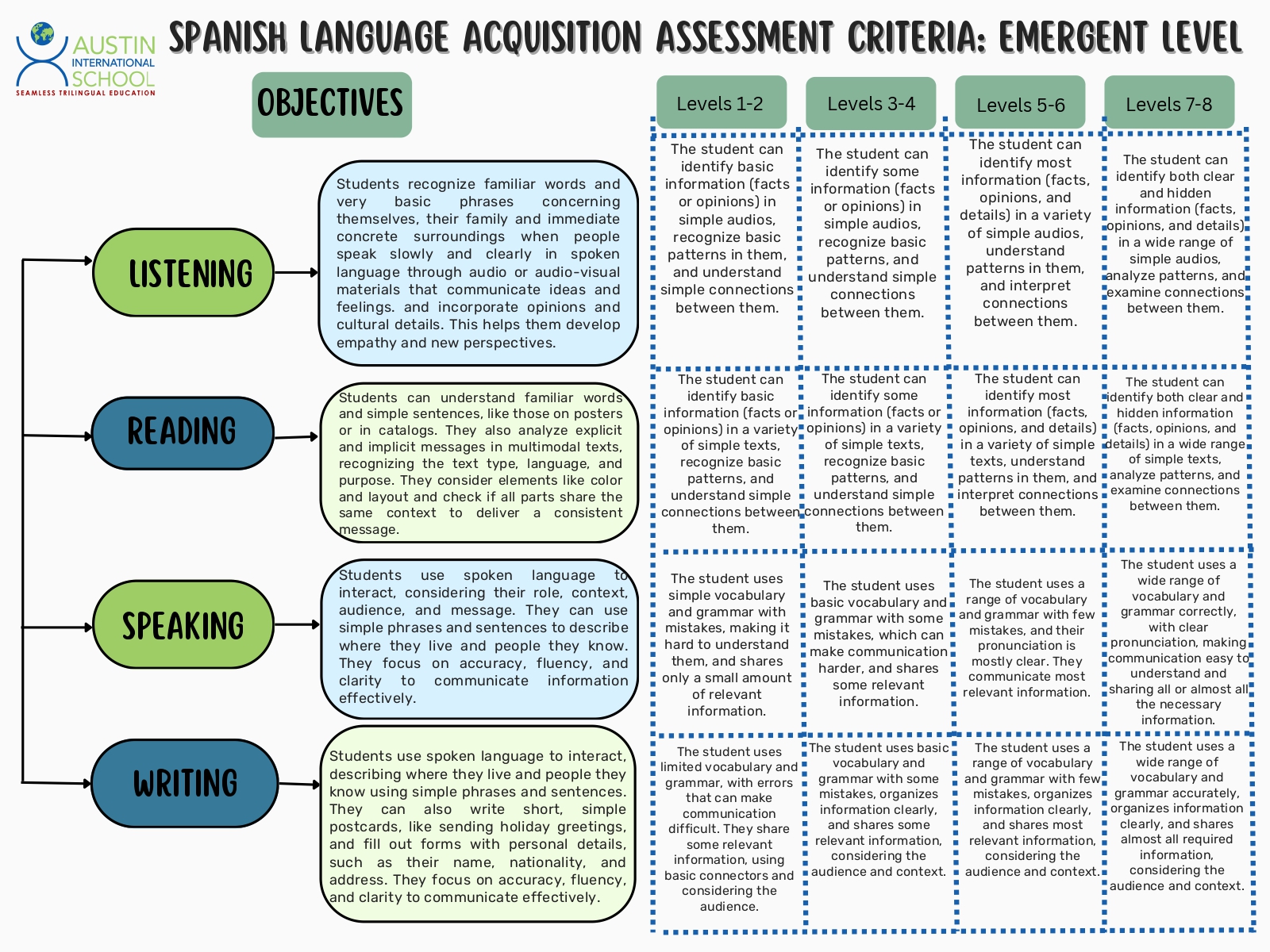
IB MYP Assessment Criteria
Subject Overview
In Year 2, the goal of the course is to facilitate the development of the student's ability to understand and use Spanish in every day and personally relevant contexts, through comprehension of frequent phrases and vocabulary, participation in conversations about familiar topics, and production of simple and coherent texts. At this stage, the focus is still on understanding and communicating basic information about themselves, their environment, and performing routine tasks effectively.
Skills
Listening Comprehension:
- Understand main ideas and specific details in conversations and short presentations on familiar topics, including some less predictable contexts
- Follow instructions and descriptions related to everyday tasks and leisure activities
Reading Comprehension:
- Identify main ideas, supporting details, and the writer’s intention in a variety of adapted and some authentic texts. Interpret information from short articles, brochures, and web pages, inferring meaning from context
Writing:
- Produce connected paragraphs with appropriate vocabulary and a range of tenses
- Write descriptions, simple narratives, and short opinion pieces using cohesive devices
Speaking & Oral Interaction:
- Participate actively in conversations, asking and answering follow-up questions to maintain interaction
- Give short presentations and narrate past events, plans, and experiences using a variety of structures
DELE A2 Escolar Preparation:
- Develop strategies to successfully complete all four skills of the official exam
Content
Communication:
- Narrating past events and personal experiences
- Talking about plans, future intentions, and wishes
- Describing routines, free-time activities, and cultural habits
- Comparing past and present experiences
- Giving and asking for information about transport, accommodation, and travel experiences
- Describing activities in nature and discussing environmental issues
- Explaining symptoms, illnesses, and giving/understanding health advice
- Talking about holidays, preferences, and types of trips
- Expressing agreement, disagreement, and opinions
Grammar:
- Pretérito perfecto compuesto
- Ir a + infinitive
- Verbal periphrases: dejar de, volver a, empezar a + infinitive
- Pretérito imperfecto
- Expressions of agreement/disagreement: a mí también, a mí tampoco, a mí sí, a mí no
- Indefinite pronouns: algo, nada, alguien, nadie
- Contrast between pretérito perfect simple and pretérito perfecto compuesto
- Temporal expressions for past tenses
- Uses of ya, todavía (no), nunca
- Future tense: regular and irregular verbs
- Adjective use of buen/bueno, mal/malo
- Conditional sentences with si + present for future meaning
- Verb doler
- Affirmative and negative imperative
- Present subjunctive: regular and irregular verbs
- Object pronouns: me, te, le, nos, os, les
Vocabulary:
- Languages and learning
- Routines, leisure activities, and free time
- Old and modern objects
- Activities for children and young people
- Means of transport and accommodation vocabulary
- Cultural activities and tourist attractions
- Geographic accidents, nature activities, and environmental vocabulary
- Parts of the body, medicines, and health-related vocabulary
- States of mind and feelings
- Volunteering, internet, and social media
- Music, concerts, graffiti, and comics
MYP Assessment Criteria
Subject Overview
Year 3 at the emergent level is a continuation of Year 2. The goal of the course is to facilitate the development of the student's ability to understand and use Spanish in every day and personally relevant contexts, through comprehension of frequent phrases and vocabulary, participation in conversations about familiar topics, and production of simple and coherent texts. At this stage, the focus is still on understanding and communicating basic information about themselves, their environment, and performing routine tasks effectively.
Skills
Listening Comprehension:
- Understand main ideas and specific details in conversations and short presentations on familiar topics, including some less predictable contexts
- Follow instructions and descriptions related to everyday tasks and leisure activities
Reading Comprehension:
- Identify main ideas, supporting details, and the writer’s intention in a variety of adapted and some authentic texts
- Interpret information from short articles, brochures, and web pages, inferring meaning from context
Writing:
- Produce connected paragraphs with appropriate vocabulary and a range of tenses
- Write descriptions, simple narratives, and short opinion pieces using cohesive devices
Speaking & Oral Interaction:
- Participate actively in conversations, asking and answering follow-up questions to maintain interaction
- Give short presentations and narrate past events, plans, and experiences using a variety of structures
DELE A2 Escolar Preparation:
- Develop strategies to successfully complete all four skills of the official exam
Content
Communication:
- Narrating past events and personal experiences
- Talking about plans, future intentions, and wishes
- Describing routines, free-time activities, and cultural habits
- Comparing past and present experiences
- Giving and asking for information about transport, accommodation, and travel experiences
- Describing activities in nature and discussing environmental issues
- Explaining symptoms, illnesses, and giving/understanding health advice
- Talking about holidays, preferences, and types of trips
- Expressing agreement, disagreement, and opinions
Grammar:
- Pretérito perfecto compuesto
- Ir a + infinitive
- Verbal periphrases: dejar de, volver a, empezar a + infinitive
- Pretérito imperfecto
- Expressions of agreement/disagreement: a mí también, a mí tampoco, a mí sí, a mí no
- Indefinite pronouns: algo, nada, alguien, nadie
- Contrast between pretérito perfecto simple and pretérito perfecto compuesto
- Temporal expressions for past tenses
- Uses of ya, todavía (no), nunca
- Future tense: regular and irregular verbs
- Adjective use of buen/bueno, mal/malo
- Conditional sentences with si + present for future meaning
- Verb doler
- Affirmative and negative imperative
- Present subjunctive: regular and irregular verbs
- Object pronouns: me, te, le, nos, os, les
Vocabulary:
- Languages and learning
- Routines, leisure activities, and free time
- Old and modern objects
- Activities for children and young people
- Means of transport and accommodation vocabulary
- Cultural activities and tourist attractions
- Geographic accidents, nature activities, and environmental vocabulary
- Parts of the body, medicines, and health-related vocabulary
- States of mind and feelings
- Volunteering, internet, and social media
- Music, concerts, graffiti, and comics
Our 8th-grade students will have the exciting opportunity to travel to Spain as a farewell to AIS. It will be a 12-day trip! During the first part of the trip, we will visit Granada and after that, students will stay with Spanish families in Murcia (southeast of Spain) and attend classes at a local school.
MYP Assessment Criteria